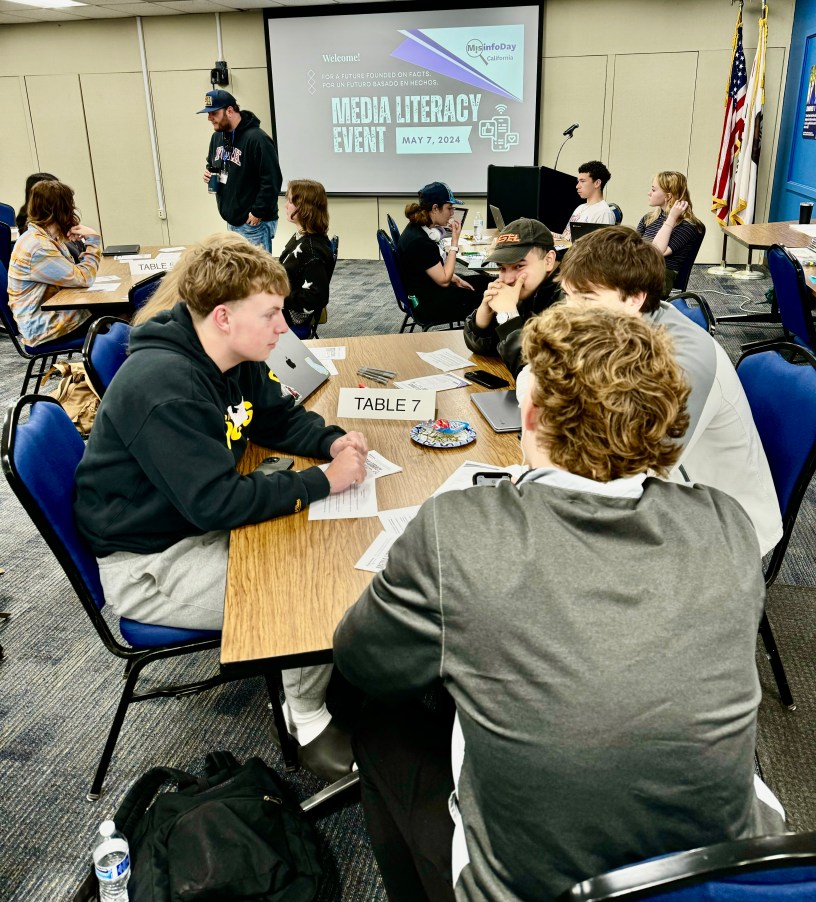
With California now requiring media literacy education in K-12 grades, educators are actively seeking the necessary expertise to equip their students with vital skills for navigating the complexities of the digital age. But in Monterey, school and community leaders aren’t waiting around for someone to tell them what to do. They are seizing the opportunity by arming their teachers and students with media literacy skills.
On Tuesday, they held California’s first ‘Misinfo Day’ and quickly became the state’s leader on media literacy education. Almost 100 high school students and their teachers participated in a workshop featuring media literacy experts. The program was patterned after the media literacy work being done at the University of Washington’s Center for an Informed Public, a national leader in identifying misinformation on the internet.
Susan Meister, a journalist and community activist in Monterey, pushed for the “Misinfo Day” in Monterey, and she and her team pulled it off in just a few months. Our Institute for Media and Public Trust at Fresno State plans to host a ‘Misinfo Day’ based on the Monterey and Washington experiences. We were one of the sponsors of the Monterey event and I presented at one of the sessions.
It was an impressive event on Tuesday. High school students were actively engaging in media literacy strategies, beginning with an “escape room” game, and then sessions on understanding the “click-bait economy,” algorithmic bias, identifying fake internet content and combatting scientific misinformation. It was a lot to take in, but the students were active learners.
The trainers included longtime educator and media literacy expert Mark Gomez; Liz Crouse, the extraordinary Misinfo Day program specialist from the University of Washington; Dr. Daisy Martin, the director of the History and Civics Project at UC Santa Cruz, and Dr. Jevin West, co-founder of Center for and Informed Public at the University of Washington.
The students had no prior media literacy skills, yet they embraced the training with remarkable ease. In watching this event, I knew that this generation of students can be taught media literacy skills that they can pass on to their classmates, family members and friends. They represent a generation of hope at a time when misinformation on the internet seems overwhelming.
It is stunning to see how the baby boomer generation, my generation, regularly posts misinformation on sites such as Facebook. Even when someone suggests the information might not be accurate, they usually double-down on the internet rumor they had posted. I’m hoping the media literacy law in California schools will somehow reach those who need it the most — older social media users.
The biggest takeaway from the Monterey event is that all of us need media literacy training. I’m urging school districts around California to start a Misinfo Day of their own, especially after AB 873 by Assembly Member Marc Berman’s was signed by Gov. Newsom.
This is what the Palo Alto Democrat said about the need for his media literacy mandate: “As we’ve seen too often in the last decade, what happens online can have the most terrifying of real-world impacts. From climate denial to vaccine conspiracy theories to the January 6 attack on our nation’s Capital, the spread of online misinformation has had global and deadly consequences. We have a responsibility to teach the next generation to be more critical consumers of online content and more guarded against misinformation, propaganda, and conspiracy theories.”
It is time that media literacy training be made available to all ages. So let’s start with the young people of Monterey and let them lead the way. On Tuesday, I was impressed with their commitment to learning how to combat misinformation. At the end of the conference, the students pledge to take home what they had learned, and share it.
If we fail to address the media literacy crisis, we’ll be condemned to unreliable information being our default setting every time we go online.
 Fresno State Institute for Media and Public Trust