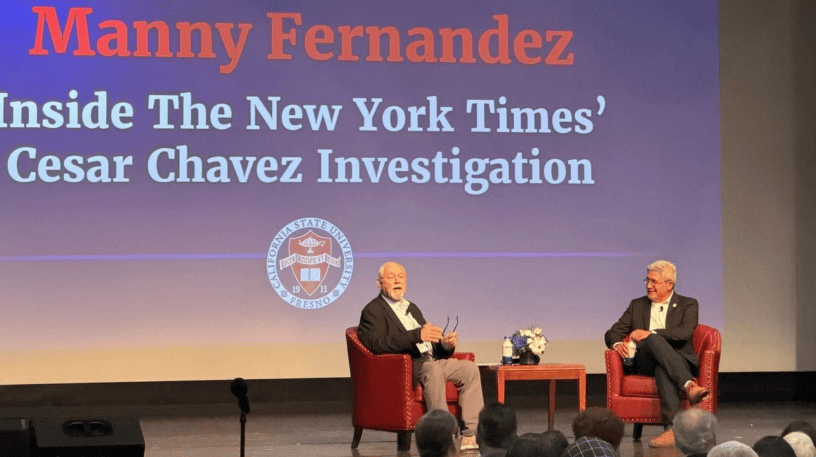
A packed audience heard Fernandez describe the extensive reporting and fact-checking behind the investigation and engage in a candid discussion about its findings.
In the region where the farmworker movement was born, and where generations of families have deeply personal ties to agriculture, New York Times journalist Manny Fernandez sat on a Fresno State stage and explained how and why his newspaper decided to publish allegations of sexual abuse that would fundamentally challenge the public legacy of farm labor leader Cesar Chavez.
The San Joaquin Valley was ground zero for the farm labor movement—a place where farmworkers marched, picketed and protested for better wages and working conditions. It’s also where sometimes the establishment, including law enforcement in some instances, responded with violence.
For generations of people in this region, Cesar Chavez was not simply a historical figure. He was a hero, a symbol of dignity and a voice for workers who had long been denied one. Seeing his legacy challenged by allegations of sexual abuse brought deep pain to many who had spent their lives believing in what Chavez represented.
It is important, though, to separate the historic advances Chavez and the United Farm Workers made on behalf of farmworkers from the terrible things he is accused of doing to underage girls and women. The two realities can exist at the same time. Recognizing the UFW’s important contributions to farmworkers does not require ignoring or excusing allegations of abuse, just as confronting those allegations does not erase the movement’s history or the gains it helped achieve for farmworkers.
The Institute for Media and Public Trust brought Fernandez to campus with the support of Fresno State President Saul Jiménez-Sandoval. I had the honor of moderating Wednesday’s conversation. Fernandez is one of our journalism alumni, and he said his Fresno State experience helped set him on the path that ultimately led him to The New York Times.
It was a packed house, with some people sitting on the floor when no seats were available — indicating how important the Cesar Chavez conversation was to our community.
The Times’ Chavez investigation took five years from the first tip about the farm labor leader to publication of the story in March. Working with reporting colleague Sarah Hurtes, Fernandez spent years pursuing leads, corroborating accounts and, ultimately, building enough trust with two women who said Chavez had abused them when they were underage.
They finally agreed to tell their stories publicly, with their names attached. Their decision to go on the record gave the investigation a weight and immediacy that would have been impossible had they remained anonymous.
Responding to critics in the audience who questioned the timing of the story, Fernandez explained that the Times would not publish the allegations until the women were willing to attach their names to their accounts. Had they agreed to go public in 2021 or 2023, he said, the story would have been published then. The reporting was essentially ready; what was missing was the women’s willingness to step forward publicly. Once they agreed to put their names behind their allegations, the story was published.
The story behind the story was fascinating. During a 90-minute conversation, Fernandez described in remarkable detail what it took to bring the investigation to publication. Other news organizations might have been willing to publish the allegations using anonymous sources, but the Times concluded that this story was too consequential to the legacy of Chavez and the United Farm Workers movement to rely on anonymous allegations.
The decision to publish carried enormous weight, and so did the responsibility to get the story right. Fernandez and Hurtes took that responsibility seriously, which led to years of reporting, corroboration and, ultimately, waiting until the women themselves were ready.
Fernandez and Hurtes are continuing to report on this issue.
What struck me most about the discussion with Fernandez was that even those who challenged his reporting came prepared to engage in a substantive discussion. It was not a conversation without emotion. The anger, hurt and skepticism were evident in some of the questions, reflecting just how deeply personal Chavez’s legacy remains for many in the Valley. Some said they didn’t believe the women were abused as teens, and one suggested that the reporting was “shameful.”
But Fernandez listened, thanked people for sharing their perspectives, and calmly explained the reporting process, including the meticulous work that went into the investigation and the decisions the Times made along the way. He maintained a mellow tone, even when some questioners misstated the facts around the story, and possible motives for the investigation.
That is exactly the kind of conversation a university should foster. A university is one of the few places where we can come together to wrestle with difficult and sometimes painful issues, challenge one another’s assumptions and debate the important questions of our time. We don’t necessarily have to reach agreement, but we can better understand why we disagree.
It was a long day leading to the public discussion. During his visit, Fernandez spent time with students, answering their questions about building a career in journalism and sharing the details of what it takes to conduct an investigation as complex and consequential as the Chavez story.
For students, it was an opportunity to hear directly from a journalist who has spent years doing the kind of difficult, painstaking reporting that defines the profession at its best. The fact that Fernandez once sat in the very classrooms they were in gave his appearance at Fresno State added importance.
In my view, the Times’ investigation was journalism at its best: methodical reporting on a controversial and deeply difficult issue. The story wasn’t rushed to print. The Times spent five years reporting, investigating and checking the facts to make sure they got it right.
As painful as the story is, it is better to have the facts brought into the open—to confront them, discuss them and debate them—than to leave them uncovered. That is the responsibility of journalism: to pursue the truth, even when the truth is difficult to hear.

